
How a Small Coffee Farm Designs Flavor: Altitude, Fermentation, Drying, Roasting

Overview: a farmer’s approach to designing coffee flavor
This article explains how one small-scale coffee farmer combines elevation, varietal choice, selective hand-picking, controlled fermentation, careful drying and targeted roasting to produce specialty coffee. The account is drawn from the farmer’s direct descriptions of practices and goals: improving taste, restoring soil health, and learning to “design” flavor during processing.
Watch this moment
- Farm history, home-stay tourism and coffee service (03:09)
- Plantation size, varieties and picking (04:08)
- Varieties: Typica and tree management (07:21)
- Altitude and climate for Arabica (08:24)
- Agroecology: macadamia shade, stopping chemicals (09:14)
- Processing overview: washing, pulping, fermentation (12:10)
- Anaerobic fermentation and pH control (13:13)
- Drying targets and temperature control (16:02)
- Small-batch roasting and roast profiles (16:54)
- Cupping, scoring and specialty thresholds (21:41)
Why elevation, varietal and hand-picking matter
Altitude and microclimate
The farmer reports her plantation sits at about 1,280 meters above sea level and notes that Arabica typically performs better at higher elevations. In her words: “the coffee likes cool weather,” so planting on a mountain helps the beans develop desirable flavor compounds. Higher elevation slows cherry development and is widely associated with greater acidity and complexity in Arabica beans.
Varietal choice and harvest selection
She grows small-yield varietals such as Typica and carefully selects ripe cherries by hand: “we must only collect ripe coffee beans to process them.” The farmer explains red cherries give fuller body and sweetness while yellow cherries offer a softer taste. Picking only ripe cherries is a practical quality-control step that reduces off-flavors and uneven fermentation downstream.
Soil, shade and reducing chemicals
The farmer describes a shift away from chemical inputs toward planting shade trees (for example macadamia) and restoring soil. She reports that after reducing chemicals the coffee tasted better and the farm became “more ecologically sound.” This is an observational claim from her experience; agroecological practices are commonly associated with improved soil health and biodiversity but yield and flavor outcomes depend on local conditions and management.
Processing: from cherry to green bean
Primary steps
She outlines the basic sequence: clean and separate cherries, depulp (remove the husk), ferment, wash, and dry. She emphasizes that processing choices are the first opportunities to “design” flavor: different fermentation methods and times produce different aromatic and taste profiles.
Anaerobic fermentation and pH control
A focal point of the farmer’s process is controlled (anaerobic) fermentation in tanks. She compares it to winemaking and measures pH to decide when to stop fermentation. She estimated one lot at approximately pH 3.5 and said that this pH was “ideal for drying in the sun.” Lower pH values indicate increased acidity produced by microbial activity.
Important caveats: the farmer’s descriptions show practical, farm-level control—measuring pH to guide fermentation duration—but do not replace controlled laboratory validation. Anaerobic fermentation can increase complexity (fruity, wine-like notes) but also carries risks of undesirable off-flavors if not monitored.
Drying: moisture and temperature targets
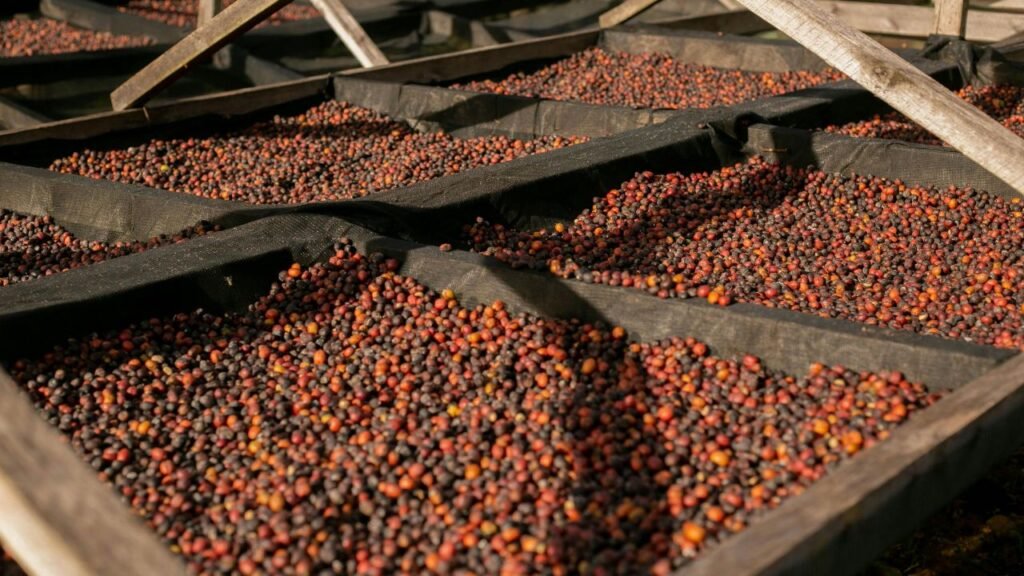
After fermentation and washing, the farmer dries parchment coffee until moisture content is low enough for storage and milling. She mentions drying until “temperature and humidity are 10 to 12” and keeping product temperatures below 40°C to avoid flavor damage. (Those numbers refer to moisture percentage or drying chamber targets in context; farmers commonly target stable moisture around 10–12% for dried parchment.)
Maintaining low temperature and good air circulation prevents spoilage and volatile loss that would alter the intended flavor profile.
Roasting: translating green bean traits into cup flavors
On-farm roasting allows the farmer to match roast profile to the processing style. She operates a small roaster and explains how roast level (light/medium/dark) and profile interact with processed flavors: many fruity or fermented coffees are roasted to highlight acidity and aroma rather than dark roast, which mutes delicate notes.
She also notes equipment matters: stainless steel fermentation tanks are easier to clean and control but are costly for small farmers—practical constraints shape processing choices.
Cupping and scoring: evaluating specialty quality
The farmer practices preliminary cupping to evaluate lots before sending them for formal competition scoring. She describes the judges’ approach—evaluating dry aroma, wet aroma and taste—and mentions that coffees scoring over 80 points (out of 100) are classified as specialty. In her own tasting she identifies cocoa-like, fruity, honey and floral notes among different samples and uses those descriptors to decide which process and roast to pair with each lot.
Her approach shows how sensory evaluation closes the feedback loop: farm management and processing choices are adjusted based on cupping results.
Practical lessons and trade-offs
- Quality starts in the field: varietal choice, picking only ripe cherries and microclimate matter.
- Processing is a primary flavor-control lever: fermentation style (including anaerobic) and duration shape acidity and aromatic complexity.
- Drying and temperature control preserve designed flavors; overheating or uneven drying introduces defects.
- Roasting must be chosen to complement processing: lighter roasts for fruity/fermented profiles, medium/darker for body-focused cups.
- Equipment and cost are real constraints: stainless steel tanks and controlled dryers improve consistency but require capital.
Questions for further investigation
- What specific microbial communities develop during her anaerobic fermentations, and how do they correlate with detected flavor compounds?
- How repeatable are pH-guided fermentation endpoints across seasons and lots? Does pH alone predict the cup profile consistently?
- What measurable soil and biodiversity changes occurred after stopping chemicals, and how do these relate to yield and cup quality?
Conclusion
This farmer’s account illustrates how small producers can deliberately shape coffee flavor through integrated decisions across cultivation, processing and roasting. Her emphasis on hand-picking, agroecology, controlled anaerobic fermentation and careful drying highlights both the sensory possibilities and the practical trade-offs—equipment costs, labor intensity and quality control—facing specialty coffee producers. Her practice-oriented approach also suggests clear research questions that could help quantify which techniques most reliably produce desired flavor outcomes.
Quoted from the farmer: “we must only collect ripe coffee beans to process them,” and fermentation is described as “similar to making wine” where pH is used to decide when to stop.
Original video: Watch on YouTube